

 The PearL monitoring system analyzes the spectrum of photoluminescent radiation emitted from a probed surface after excitation with laser light. It is designed for in-line integration in production lines. Spectroscopic photoluminescence (sPL) gives access to information on the band gap, electronic defects and the related composition of materials, e.g. the gallium / (gallium+indium) ratio (Ga/(Ga+In) ratio) and copper (Cu) content of CIGS solar cells. LayTec’s sPL has a total measurement and analysis time of only 100 ms.

PearL's advantages under production conditions:
- Reliable CIGS characterization across the full module length at different points
- Spatially resolved information about band gap, material composition and quality of the ###HIDE###CIGS absorber material
- Analysis of the absorber directly after its deposition without interference of other layers
- Identification of faulty substrates before the cost-intensive back-end processing
- Measurement time of only 0.1 s.
Find more information and measurement data in our PDF newsletter
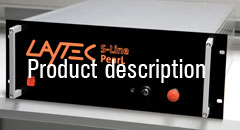
PearL is based on LayTec’s modular platform for in-line optical set-ups. Up to three optical heads can be attached to a single PearL controller, to monitor the composition simultaneously on three traces on moving specimen. This allows accurate monitoring of the center to edge uniformity of the material composition.
A controller unit contains all optical and electronic components including a real-time embedded controller for maximum reliability. Optical fibers guide the measurement light between the controller unit and the measurement positions. Miniaturized measurement heads provide optimum optical performance with a small footprint. Sophisticated automated analysis, monitoring, and storage of the data are provided by a metrology PC connected to the controller unit. In addition, PearL can also be integrated with production machines and software systems via a large variety of protocols such as OPC, Ethernet, ProfiBus, and others.
Typical accuracy of the measurement at PL Peak position is ± 0.5 nm. With this resolution, the sensitivity to the Ga content in CIGS is ± 0.01 GGI, where CCI is the molar gallium/(gallium + indium) ratio.
For further technical information and measurement examples please download our Application Note
To find out how PearL can optimize your CIGS process please contact mail@laytec.de or simply call +49(0)30 89 00 55-0.
Product information:
Fields of application:
- Fast detection of the effective Ga content of the absorber in CIGS-based production lines
- Product version for CdTe absorbers also available
Product features
- Adaptable to every in-line process via customized optical heads and mounts
- In-line integration for 100% inspection of produced modules
- Spatially resolved spectral photoluminescence measurements through multiple heads
- Fast data acquisition for in-line measurements on moving substrates
- Up to 10 measurements per second
- Automated spectrum analysis calculation of key parameters e.g. Ga/(Ga+In) and Cu content of CIGS layers
- PV-line software integration via Profibus, Ethernet, TCP/IP or other protocols for automated operation
Product news
PearL qualified for CIGS monitoring in high-volume PV production
Downloads
- PearL Data Sheet
- Application Note: Spectroscopic in-line photoluminescence of solar cell materials with PearL